In a city built on the edge of a vast desert, rain is more than just weather—it’s an event. For years, the mystery of how a hyper-arid region like the UAE receives its downpours has sparked debate, ranging from “is it all cloud seeding?” to “where does the water come from?”
The truth is a complex “atmospheric dance” involving global wind systems, mountain ranges, and cutting-edge technology. Here is the breakdown of how the rain finds its way to Dubai.
1. The Engines of Nature: Three Main Systems
While we often see rain as a single event, it is usually driven by one of three distinct meteorological triggers:
- The Winter Trough (Frontal Rain): Most of Dubai’s rain occurs between December and March. This happens when cold air from the Mediterranean or Siberia moves toward the Gulf, meeting the warm, moist air sitting over the Arabian Sea. This “clash” creates a low-pressure system (or trough) that forces air to rise, cool, and condense into rain clouds.
- The Hajar Mountain “Lift” (Orographic Rain): Have you ever wondered why it’s pouring in Hatta or Fujairah while Dubai is sunny? The Hajar Mountains act as a physical wall. When moist winds hit the mountains, they are forced upward (Orographic Lift). As the air rises, it cools rapidly, forming “convective” clouds that dump heavy rain and hail over the eastern regions.
- The Summer Monsoons: Occasionally, the edge of the Indian Monsoon reaches the UAE. This brings humidity and the “Khareef” effect to the south and east, occasionally triggering sudden, intense afternoon thunderstorms.
2. The Human Element: Cloud Seeding
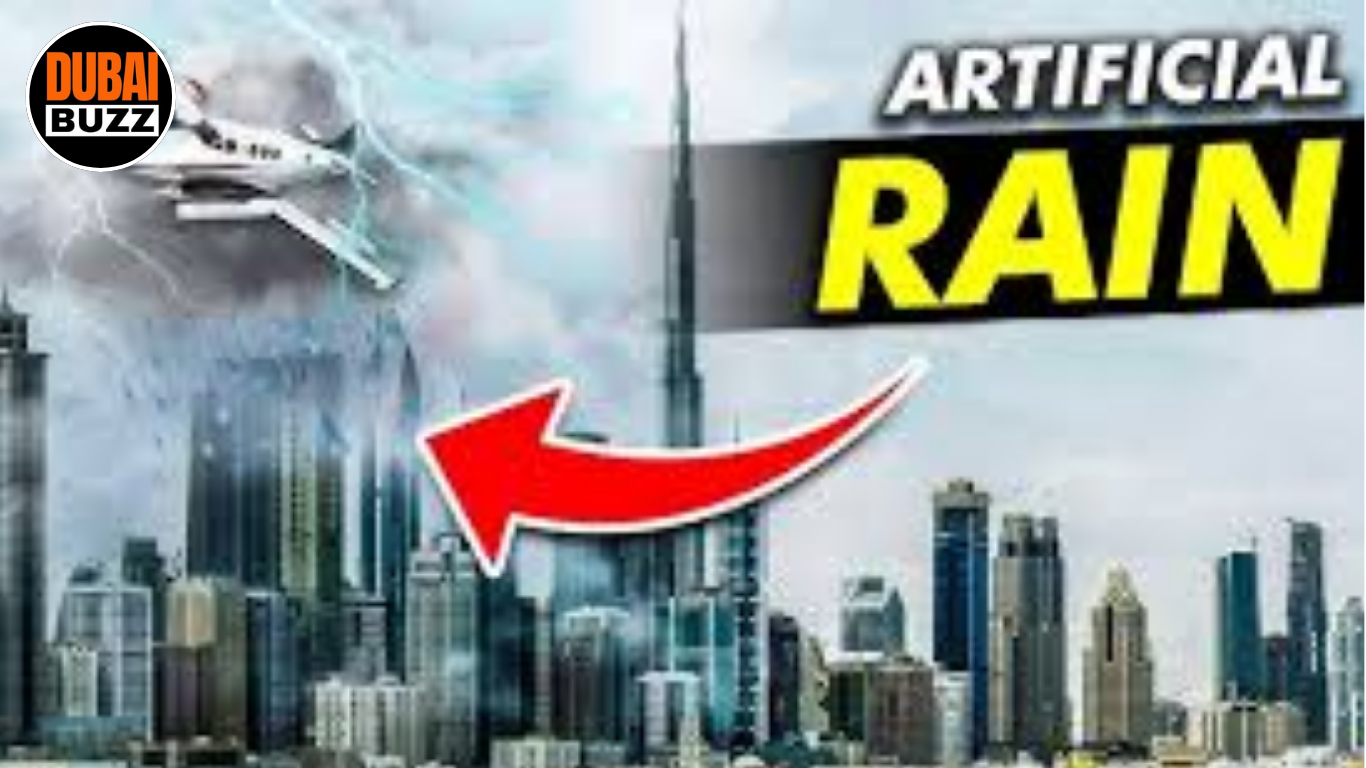
The UAE is a global leader in Rain Enhancement Science. Contrary to popular myth, cloud seeding cannot create a cloud out of thin air; it can only “encourage” an existing cloud to be more productive.
- How it works: When meteorologists at the National Centre of Meteorology (NCM) spot a “promising” convective cloud (one with strong upward drafts), they scramble specialized aircraft.
- The Catalyst: These planes fly into the base of the cloud and release hygroscopic flares containing natural salts (like sodium chloride and potassium chloride). These salt particles act as “magnets” for water vapor, helping tiny droplets collide and grow heavy enough to fall as rain before the cloud evaporates.
- The Result: Studies suggest cloud seeding can increase rainfall by 10% to 30% in a favorable atmosphere.
3. The Changing Climate: “Atmospheric Rivers”
In recent years, including the historic events of April 2024 and the current March 2026 trough, we have seen “Extreme Weather Events.” Scientists point to two factors:
- Warmer Air: For every 1°C the atmosphere warms, it can hold 7% more moisture. This means when it does rain, the “bucket” being tipped over the city is much fuller than it was 30 years ago.
- Cut-off Lows: Sometimes, a low-pressure system gets “trapped” over the peninsula, fed by a steady stream of moisture from the Arabian Sea (often called an Atmospheric River). This leads to the multi-day “waves” of rain we are currently experiencing.
Summary: The “Rain Recipe”
| Ingredient | Role |
| Moisture Source | The Arabian Gulf and Arabian Sea provide the “fuel.” |
| Lifting Mechanism | Mountains or Low-Pressure Troughs push the air up. |
| Cloud Seeding | Salt flares help the droplets get “fat” enough to fall. |
| Climate Change | Increases the intensity and volume of the downpour. |
#DubaiBuzz #ScienceOfRain #CloudSeeding #UAEWeather #Meteorology #DubaiClimate #NCM #SustainabilityUAE #NatureTech