
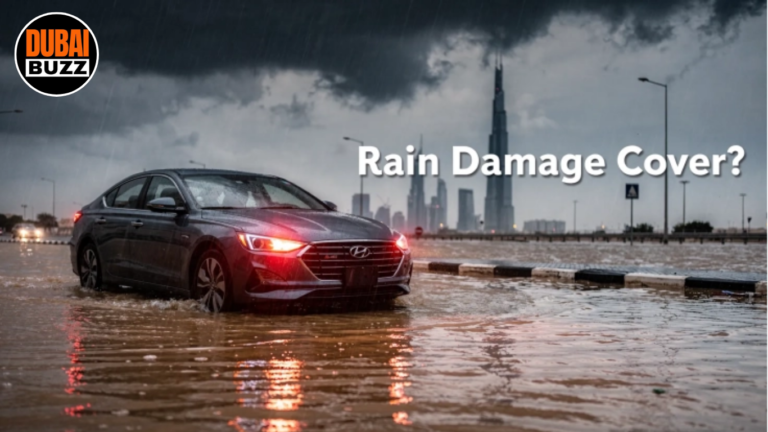
DUBAI, UAE – As the current weather trough intensifies, with rainfall potentially reaching historic levels, thousands of residents are asking one critical question: “Is my car actually covered?”
The answer in 2026 is more encouraging than in years past, but a few “fine print” traps could still leave you with an AED 50,000 repair bill. Here is the definitive guide to navigating car insurance during this storm.
1. The 2026 Legal Milestone: Mandatory Natural Disaster Cover
Following the historic rain events of the mid-2020s, the UAE Financial Services Authority updated the Unified Motor Vehicle Insurance Policy. As of early 2026, “Natural Disaster” coverage is no longer an optional “add-on” for many—it has been integrated into the standard legal framework.
- What this means: Most policies issued or renewed in 2026 now automatically include protection against rain, hail, and flooding.
- The Catch: If you are still on an older policy (pre-2026 renewal) or have the most basic Third-Party Liability (TPL), you may still be at risk. TPL covers damage you cause to others, not damage to your own car from rising water.
2. The “Parked vs. Driven” Rule (The Claim Killer)
This is where most claims are rejected. Insurance companies categorize flood damage into two buckets:
- Covered: Your car was parked in a designated area (street, driveway, or basement) and the water rose around it.
- Denied: You ignored government “Stay Home” alerts and intentionally drove into a waterlogged area or a flooded tunnel.
Rule of Thumb: If the engine “hydro-locks” because you tried to ford a deep puddle, the insurer may argue you “contributed to the loss,” potentially voiding your claim.
3. Step-by-Step: What to do if your car is flooded
If you wake up to find your car partially submerged, DO NOT START THE ENGINE. Turning the key can pull water into the cylinders, causing instant, irreparable engine failure.
- Document Everything: Take photos and videos of the water level against the car before the water recedes. Capture the interior if water has entered the cabin.
- Get the “To Whom It May Concern” (TWIMC) Certificate:
- Dubai: Apply via the Dubai Police App under “Certificate Services” -> “Natural Disasters.” (Cost: AED 95).
- Abu Dhabi: Use the Saaed App to file an “Unknown Accident” report.
- Sharjah: Use the Sharjah Police App for the digital damage certificate.
- Call for Recovery: Contact your insurance provider’s Roadside Assistance (RSA). Do not use a private recovery truck unless authorized, as the insurer may not reimburse the towing fee.
4. Checklist: Are you “Weather-Proof”?
| Feature | Third-Party (TPL) | Comprehensive (2026 Standard) |
| Engine Hydro-lock (Parked) | ❌ No | ✅ Yes |
| Hail Damage to Bodywork | ❌ No | ✅ Yes |
| Interior/Electrical Damage | ❌ No | ✅ Yes |
| Towing/Recovery | ❌ Usually No | ✅ Usually Yes |
The Bottom Line
In 2026, the UAE has made it easier to stay protected, but documentation is your best friend. An official police certificate is mandatory for a claim. Without that digital certificate from the Dubai Police or Saaed apps, your insurance company cannot legally process your file.
Stay home, keep your car on high ground if possible, and let the storm pass.
#DubaiBuzz #CarInsuranceUAE #DubaiRain #StaySafeDXB #InsuranceTips #DubaiPolice #Saaed #UAEBusiness #FloodSafety #MyDubai